
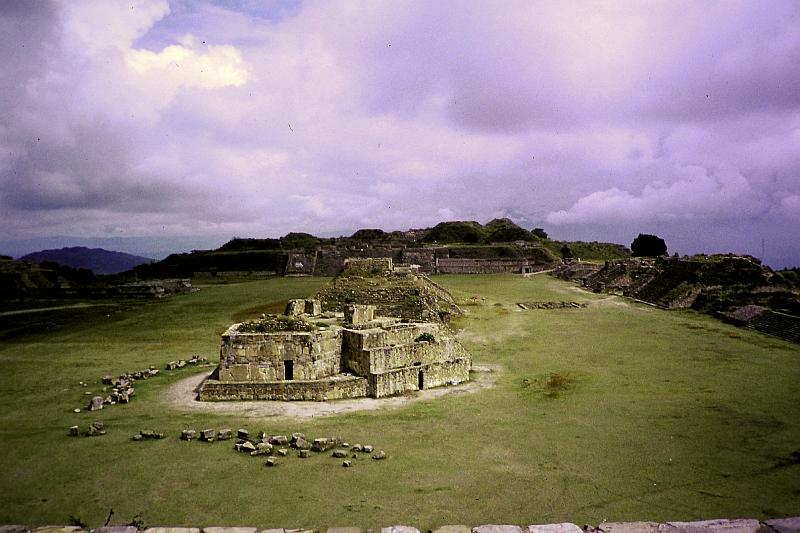
Temple Mitla – Oaxaca, Mexico – © Victor Onrust
Introduction
Realism is an attempt to describe social reality, stripped as much as possible of political, moral, or ideological views.
Such a description can never be completely objective or neutral. It’s impossible to describe society from the outside, as if the author isn’t part of that society; the description will retain a certain inclination and merely approximate the very complex reality as closely as possible.
This realist manifesto defines the manner in which research of social reality must be conducted according to the principles of evolutionary systems theory. Realist research is a precondition for describing social reality – in literature, essays, social science, the press – in a realist way.
Evolution is development of a living entity, a living system – in this case society at large.
It follows that research into the origins of social reality is the primary object. As evolution has no goal (objective) this is the most neutral theory to use.
The goal of describing social reality
Describing social reality has in itself a goal: a political goal. If all goes well and every citizen is content with his life and role in society, there is little use in researching and describing social reality.
When external or internal developments threaten the smooth continuation of social life. A proper description of the situation is necessary.
Society has to be governed, and this means that every social order is a power structure. When serious problems arise, the top will try to generate a description that suits them, ascribing the problems to external developments, or to a special group that is of little importance and power. In Western societies Jews were (and are) a long time favorite. Now it seems they have been replaced by the ‘old white male’.
Effective opposition is only possible on the basis of a realist description of the problems. Producing and propagating such a description is the most important task for opposition.
Thus, any description of social reality that is not published in a way it has some impact on social reality is useless. A primary condition for any form of democracy is an authority that ensures that proper publication is possible for any description that adds to the knowledge of social reality. Whether it is criticism of the ones in power or the ones in opposition.
Nowadays, X (formerly Twitter) seems the best guarantee for publication. But there are serious flaws.
It is based on clicks from the masses and leans primarily on advertising, the consequence is that messages that generate positive feelings in the audience get a lot of traction, and messages based on rational thought and knowledge are less popular. In this way it is not a replacement for the media aimed at the intellectuals who form the main element of the power structure. In the US media like the NY Times, Washington Post and CNN.
Principles
This research should be executed according to the following principles:
- Moral judgments and ideals should be avoided.
- Victim/blame and linear cause/effect as explanations should be avoided.
- Institutions are the primary object of research, not individual persons.
- Insight into the correct conditions for creating knowledge about society.
The topics of Realist research, based on these principles:
- Western culture in its broadest sense.
Economical and technical, Western culture has invaded the whole world, including China. Ideological, moral (legal) and cultural differences across the world are still huge, even between countries in the Western cultural sphere. Realist research should be aimed at continuation of these differences, as they provide important values for a proper human identity.
Western civilization finds itself in an economic, moral and ideological crisis. The prevailing philosophy of life has a strong individualistic and universalist point of view. Such universalism conflicts with biological limitations that still control humans and cannot function as a unifying factor between people.
- The global economic order: multinational capitalism.
This is the most important, most defining globally operating assembly of institutions of Western civilization. It is the root cause for the crisis of the West the past twenty years. Every year, this crisis is becoming more severe.
The knowledge to be acquired must contribute to the reorganization of that order. There is no global democratic power serving the citizens that can enforce a reordering on a global scale. Realistic knowledge is aimed at enabling change on an Anglo-European scale.
- The way individuals are incorporated into the power networks of institutions and assigned their place in these institutions; the permanent and necessary inequalities between individuals and between institutions that arises from that order.
Inequalities are fundamental to every form of life, including human societies. The goal for researching these inequalities is not to abolish those inequalities but to optimize them for all concerned. - The conditions for an independent existence as state.
For its existence, human and cultural reproduction within the state must continue. When cultural differences within a state are getting bigger, possibilities for peaceful coexistence within a state or federation get reduced. Maintaining borders with other states is essential. - Analyzing the functioning of the institutions – democracy, rule of law, education, healthcare, science, market, companies, media, military, faiths – that collectively constitute Western civilization. Includiisg their (historical) interaction.
The implicit consensus among citizens, necessary for these institutions to function, is undermined by an ideological crisis, and so the functioning of the institutions themselves. This consensus – based on shared values – takes shape in constitution, treaties, and other legislation, and the institutions based thereon. When consensus is significantly diminished, the laws and the institutions based on it, can function no longer. - Population policy. This concerns, among other things, population growth and decline, external and internal migration, population composition, healthcare, upbringing, education, and life philosophy.
Problems that should be addressed first
- Freedom of opinion is an integral part of democracy:
Criticism must not only be voiced.
First and foremost, it must be heard. - What measures should be taken against groups or individuals – especially citizens – who clearly position themselves outside the established consensus for social interaction, and thereby effectively undermine society.
- How to reform (criminal) law to its historical role to protect society against misbehavior that damages society. The purpose of justice should be to stop behavior that harms society. Rehabilitation or punishment are of less importance. Exact proof of guilt is not that important.
- The way European society is organized as a failing multitude of cooperating but foremost competing institutions, including the European states themselves.
The above descriptions are formulated as factually as possible, without moral judgment. Criticism on these premises must also adhere to these standards.
Realism is necessary to present future developments that could be realized. It is the only way to find and support the most desirable of those developments.
Whether a development is or is not desirable should be the only act based on moral judgments.
1st English version 260411
based on 4th Dutch version.
