
The SoLiDe movement aims to transform society according to the principles of Social Humanism and to elaborate on these principles.
SoLiDe stands for a new content and interconnectedness of the following ideals:
- Socialism as an ideal that recognizes the social, historical nature of man as its foundation.
- Liberalism as an ideal that recognizes personal responsibility and freedom of choice.
- Democracy as a means to structure society based on Socialism and Liberalism.
Most important, SoLiDe stands for Solidarity.
The foundation of our moral principles.
All these worn-out and misused concepts must be given new meaning:
not old wine in new bottles, but new wine in old ones.
The movement …
- Regards itself as an unfinished work, subject to critical scrutiny. Criticism, substantiated by knowledge and insight.
- Is an ideological movement and not a political party; its primary function is to develop and disseminate a more fitting moral framework. Goals derived from this serve as signposts and not as prescriptions for a utopia.
- Aims to achieve this by exerting influence on existing organizations or by forming new organizations based on the SoLiDe philosophy.
- Develops a variety of culture and rituals in which participants can experience the SoLiDe ideas in their own way as a shared entity, as something that connects them. In doing so, the glorification of individuals and leadership is constantly combated.
Individual and Society
- The core of our moral principle is solidarity: a mutual obligation to work together towards a goal and to stand by one another. It isn’t a self-evident brotherhood based on the natural goodness of man. Nor is it about achieving a state in which everyone can, must, wants, and receives the same.
- Personal initiative, responsibility, and creativity are important. The freedom necessary for their development is important too. For successful creations, a reasonable material reward is usual.
Creations are the result of a history that does not begin or end with the individual. We want to set a limit to excessive forms of appropriation of the products of society by individuals based on so-called personal merit. - The SoLiDe movement wants to retain private ownership of the means of production with a clear entrepreneurial role for the owners. All other forms of ownership of the means of production must be socialized. Inheritance by descendants applies only to private property and possibly a right to income without labor. It recognizes the market as an important economic steering system that enables freedom. Making a profit is a legitimate goal for an organization, primarily to increase the chances of its own survival. And thereby security for its participants.
- We strive for improvement through the democratization of institutions and organizations. We view democracy as a mechanism for both qualification for participation in decision-making based on knowledge and skill, and as a mechanism for decision-making itself. The prevailing view of parliamentary democracy is too limited.
Humanity, world, nature
- The SoLiDe movement regards the Enlightenment, the humanisms, capitalisms, and democracy stemming from it, as the superior culture and way of life. The current failure of this system must lead to improvement, not to abolition. This does not result in a desire for domination or the immediate absorption of other cultures, but rather the maintenance of dominance. It rejects the equality of cultures.
- The value of the life of an individual specimen, can be smaller or larger depending on species and circumstances. This applies to both plant and animal life, including human life. The valuation of life is a cultural, social, and historical given, subject to debate. There is no valuation stemming from nature or from the individual upon which one can rely.
- The SoLiDe movement strives for the improvement of the condition of humanity. It acknowledges differences between groups and cultures and does not view inequalities as undesirables that must be eliminated by definition. History cannot be undone and can only in exceptional circumstances be a reason for special treatment of perpetrators and victims. Inequalities are not a reason in themselves, and an assessment of past actions with the knowledge of the present is only possible to a limited extent.
- The interaction with nature: the capitalist economy, is a globally functioning system that threatens to derail, if it has not already done so. There is an urgent need for global and cultural-regional regulation and limitation. International cooperation and the establishment of federations of states are a prerequisite for this.
Translated and edited from Dutch version 5.51 dd 220605
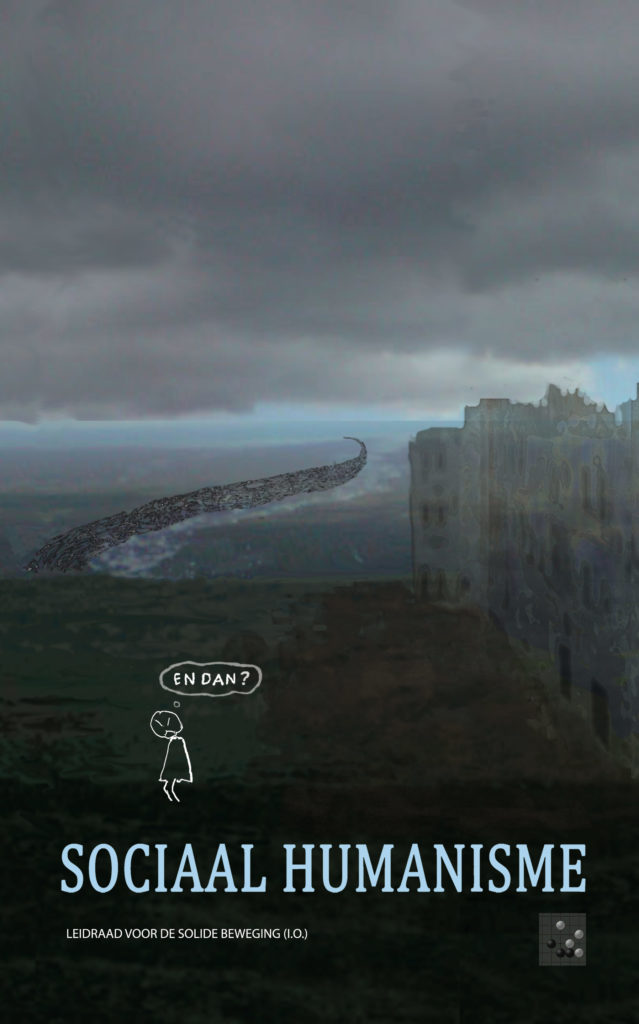
This Manifesto was written in 2016. It was meant as a means to ground the SoLiDe movement. Such a movement or a similar one – based on solidarity – is a precondition to prevent the present collapse of Western culture, especially in Europe.
More about this movement can be found in the book Sociaal Humanisme. At this moment only available in Dutch. Hopefully in 2016 at least parts of it will be available in English.
